
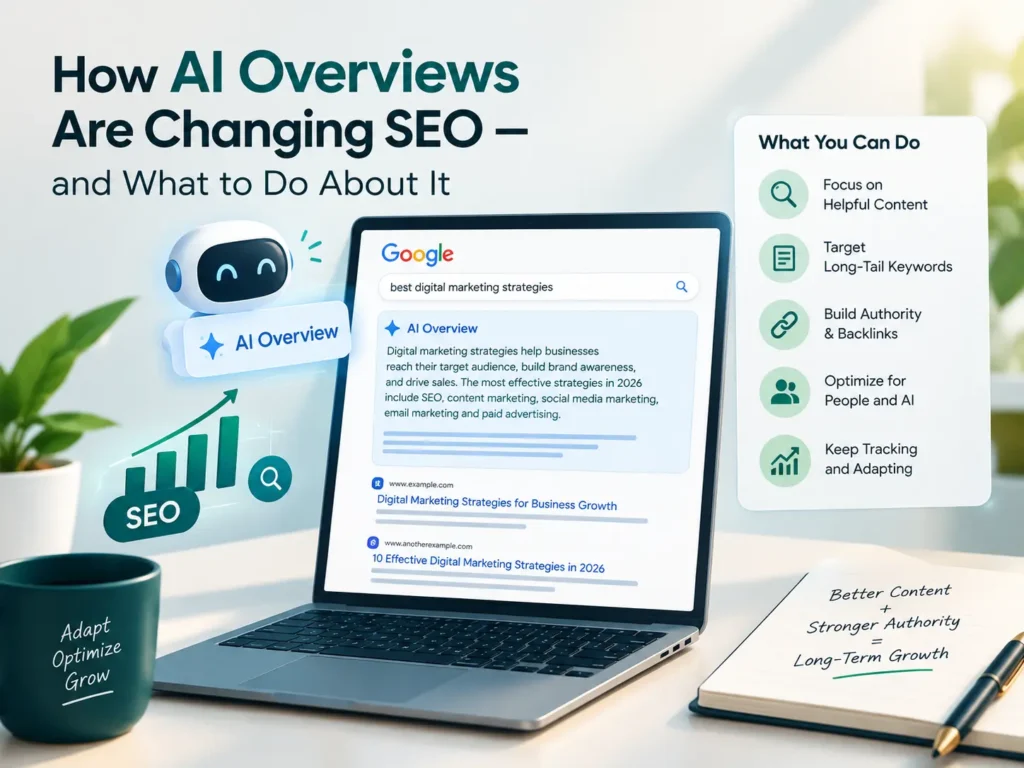
How AI Overviews Are Changing SEO — and What to Do About It
1. Introduction
Looking for the best AI Overviews and SEO strategy?Start with a number worth sitting with: 58.5% of Google searches in the US now end without anyone clicking anywhere. And if the search actually triggers an AI Overview, that jumps to 83%. Without one, it’s 60%.
That 23-point gap tells you almost everything you need to know about where this is heading. The easier a question is to answer directly, the less reason Google has to send anyone to your site to answer it.
This isn’t another “SEO is dead” post — those have been wrong for about fifteen years running. It’s more that the finish line moved, and a lot of us are still running toward where it used to be. Below: what’s actually changed, why Google picks what it picks, and what’s still worth doing about it.
2. What Are AI Overviews, Quickly
People sometimes lump these in with the old featured snippets, but they work differently. A featured snippet grabbed one chunk of text from one page and displayed it. An AI Overview reads across several sources and writes something new — an answer that might cite five pages, or none in particular, depending on how confident the system is.
A few practical differences:
- It’s generating an answer, not extracting a quote
- It can pull from multiple sources in the same response
- It handles messier, multi-part questions that a snippet never could
As for where they show up: roughly 48% of tracked queries triggered an Overview as of February 2026, up 58% from a year earlier. They cluster heavily around informational stuff — definitions, comparisons, “how do I” questions — and show up much less on transactional, local, or branded searches, where people still need to actually go somewhere to buy or book or verify something.
3. What This Is Doing to Traditional SEO
The plain version: ranking #1 doesn’t mean what it used to.
One DACH-market study found position-1 CTR dropping from 27% (no AI Overview present) to 11% (with one) — close to a 60% cut, for the same ranking position. More broadly, AI Overviews are knocking organic CTR down by something like 18% on average, though the traffic that does still click through seems to convert better, presumably because they’re already somewhat sold before they arrive.
The number that stings most for publishers comes from Pew: when an AI Overview shows up, people click through to a cited source about 1% of the time. Not 1% of clicks — 1% of views.
So the metric that used to matter — where you rank — is quietly being replaced by a different one: whether you get named. Getting cited inside the answer, even with zero clicks attached, is starting to carry real value that the old click-based model has no way to count.
Not everything’s affected equally, though. Definitions, comparisons, basic how-tos — that’s the content getting absorbed wholesale. Transactional and local searches are holding up better, mostly because the whole point of those searches is to end up somewhere specific, not just to know something.
4. How Google Decides What to Cite
There’s no published formula for this, unsurprisingly. But a few patterns keep showing up in what practitioners are noticing:
Content that’s easy to lift tends to get lifted — clear headers, answers stated plainly rather than buried three paragraphs into a story, lists and tables where they make sense. Schema markup seems to help the system understand what a page is actually claiming. Freshness matters more on fast-moving topics. And E-E-A-T — experience, expertise, authority, trust — matters more here than it did for classic rankings, not less, because the system has to decide which sources it trusts enough to synthesize from without a human checking its work.
None of this is new SEO advice, really. It’s just that the stakes for getting it right changed.
5. What Actually To Do About It
A few shifts that seem to be making a difference:
Say the answer early. Whatever question a section is answering, answer it in the first sentence or two. Put the nuance and caveats after, not before.
Chase the follow-up question, not the first one. An Overview will happily answer “what is technical SEO.” It’s much shakier on “how do I fix a technical SEO issue on a WooCommerce store with 40,000 SKUs.” That specificity gap is where there’s still room to actually earn a click.
Lean harder into original material. Data you collected yourself, a named author who’s actually done the work, real case studies — these are much harder for a generic synthesis engine to absorb and flatten, and more likely to get you named as the source instead of disappearing into the summary.
Structure for citation, not just ranking. Schema markup, clearly defined terms, content shaped so a machine can lift a clean answer without mangling it.
Stop leaning entirely on organic clicks. Email, communities, social, YouTube — none of these route through the same zero-click funnel Google search does. If organic starts acting more like a billboard than a doorway, the other channels need to pick up the slack.
Track different things. Add impression share and AI Overview appearance rate and brand mentions inside AI answers to what you’re already watching. Don’t drop CTR and rankings — just stop treating them as the whole picture.
6. What "Success" Even Means Now
The old metrics aren’t wrong, they’re just incomplete:
- How often you show up in AI-generated answers, not just where you rank
- How often you get cited by name
- Whether branded search goes up after people see you in an Overview
- Conversions that trace back to a zero-click impression, measured more like a brand campaign than a last-click one
The tooling for a lot of this is still catching up — expect it to keep shifting through the rest of 2026.
7. Conclusion
SEO isn’t dying. It’s turning into something closer to answer ownership than traffic acquisition. The people who treat this as a structure-and-authority problem, rather than just a keyword problem, are the ones who’ll keep showing up inside the answer — even as fewer and fewer people click their way out of it.
Worth doing this week: pull up your best-performing pages and ask honestly whether each one leads with a direct answer, is structured cleanly enough to lift, and would actually be easy for a retrieval system to cite without a rewrite.