
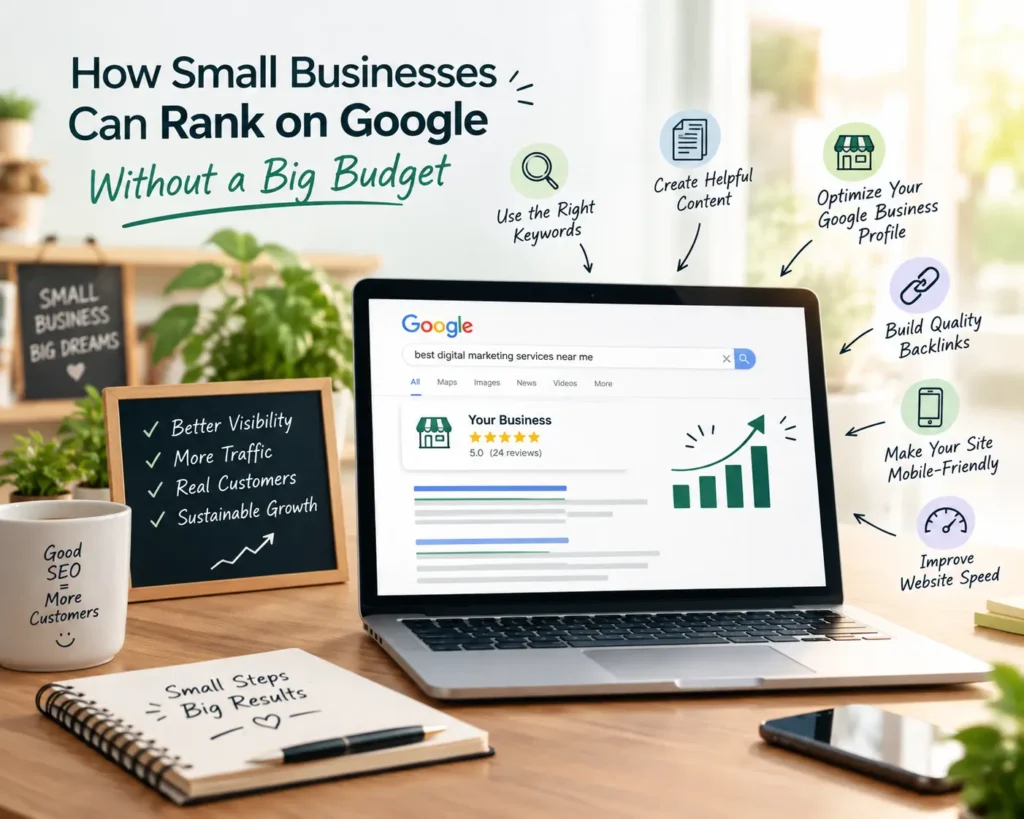
How Small Businesses Can Rank on Google Without a Big Budget
Let’s get one thing out of the way: you don’t need a big ad budget to show up on Google. It helps, sure, but it’s not the whole game. What actually gets small businesses ranking is a lot less glamorous — showing up consistently, answering real customer questions, and putting in the kind of unpaid effort most competitors won’t bother with.
Think of it as sweat equity. Every listing you clean up, every post that answers a question someone actually asked you, every link you earn from a genuine local connection — it all adds up. No credit card required, just a plan you’ll actually stick to. Here’s that plan, using nothing but free tools.
1. Claim Your Google Business Profile (It’s Free)
If you only do one thing off this list, make it this one. Go claim your listing and actually fill it out — category, hours, service area, photos, a real description. Leaving half of it blank tells Google (and your customers) that nobody’s minding the store.
This is huge for “near me” searches. When someone types “bakery near me,” Google is leaning hard on your Business Profile to decide whether you make the cut for that local map pack. And don’t ignore reviews — ask happy customers for them, and reply to every single one, good or bad. It shows you’re paying attention.
2. Find Keywords Without Paying for Tools
Skip Ahrefs and SEMrush for now. Just start typing a phrase into Google and watch what autocomplete throws back at you. Scroll down to “People also ask” while you’re at it — that’s real people, phrasing real problems, for free.
If your site’s been live a while, Google Search Console will show you what you’re already ranking for, sometimes without even trying. That’s often the easiest win around — a small tweak can push something from page two onto page one. And chase the specific stuff: “emergency plumber in [your town]” beats “plumber” every time, because you’re not fighting the whole internet for it.
3. Handle the On-Page Basics Yourself
You don’t need a developer for this part. Write title tags and meta descriptions that actually say something specific — include your keyword, give people a reason to click. Keep your headers organized: one H1, then H2s and H3s doing their job underneath.
Stop uploading photos named “IMG_4821.jpg.” Rename them, describe them in the alt text, and you might pick up traffic from Google Images that you’re currently leaving on the table. And link your own pages to each other — if you’ve written about flooring, point that post at your flooring services page.
4. Write Content That Solves Actual Local Problems
Here’s where most small businesses get stuck — not knowing what to write about. But you already have the answers, sitting in your inbox and your call logs. Every question a customer has ever asked you is a blog post waiting to happen.
If you cover multiple neighborhoods or towns, build a page for each one. It sounds tedious, but those hyper-local pages rank for searches your generic homepage never will. And one solid, useful post genuinely beats ten thin ones nobody needed.
5. Earn Backlinks Without Spending a Cent
Start simple: your chamber of commerce, local directories, industry listings. Then look sideways — find businesses that serve the same customers without competing with you, and swap links. A wedding photographer and a florist, say.
Offer yourself up as a source to local news, podcasts, or community blogs. Try guest posting somewhere in your niche. None of it happens fast, but these links stick around in a way paid ones just don’t.
6. Get Your Citations and Social Proof in Order
Make sure your name, address, and phone number look identical everywhere — every directory, every profile. Even “St.” versus “Street” can trip things up more than you’d expect. Encourage customers to post photos, tag you, leave specific reviews — that kind of organic proof is hard to fake and easy to trust. Social shares won’t move your rankings directly, but they get more people searching your name, which helps anyway.
7. Cover the Technical Basics (Still No Developer Needed)
Compress your images before uploading them, then run your site through PageSpeed Insights to see what else is slowing you down. Check that it actually works well on mobile — that’s where most local searches happen now. Confirm you’ve got an SSL certificate; most hosts throw this in for free these days. And every so often, run something like Screaming Frog’s free tier to catch broken links before they quietly hurt you.
8. Track What’s Actually Working
Google Search Console and Google Analytics will tell you everything you need to know, and neither costs anything. Watch impressions, clicks, and where you’re ranking for the terms that matter to you — not just how many people visited your site overall.
And be patient with it. Real movement usually takes three to six months. That’s frustrating to hear, but it also means the businesses giving up early are handing you the opening.
Wrapping Up
Ranking without a budget isn’t a trick — it’s just choosing to invest time instead of money. Fix up your Business Profile, write about what your customers actually ask you, earn a few honest backlinks, and keep an eye on the free data telling you what’s working.
Don’t try to tackle all eight of these at once. Pick one, maybe two — your Business Profile and your keywords are the obvious place to start — and give it real effort this week. The businesses that win at local SEO usually aren’t the ones with the deepest pockets. They’re just the ones who kept showing up.
Lorem ipsum dolor sit amet, consectetur adipiscing elit. Ut elit tellus, luctus nec ullamcorper mattis, pulvinar dapibus leo.
Lorem ipsum dolor sit amet, consectetur adipiscing elit. Ut elit tellus, luctus nec ullamcorper mattis, pulvinar dapibus leo.