
On-Page vs Off-Page SEO: What Small Businesses Actually Need in 2026
Here’s a pattern I see constantly: a business owner either writes off SEO as “too technical,” or gets talked into a $99 backlink package that does nothing. Both mistakes cost real money.
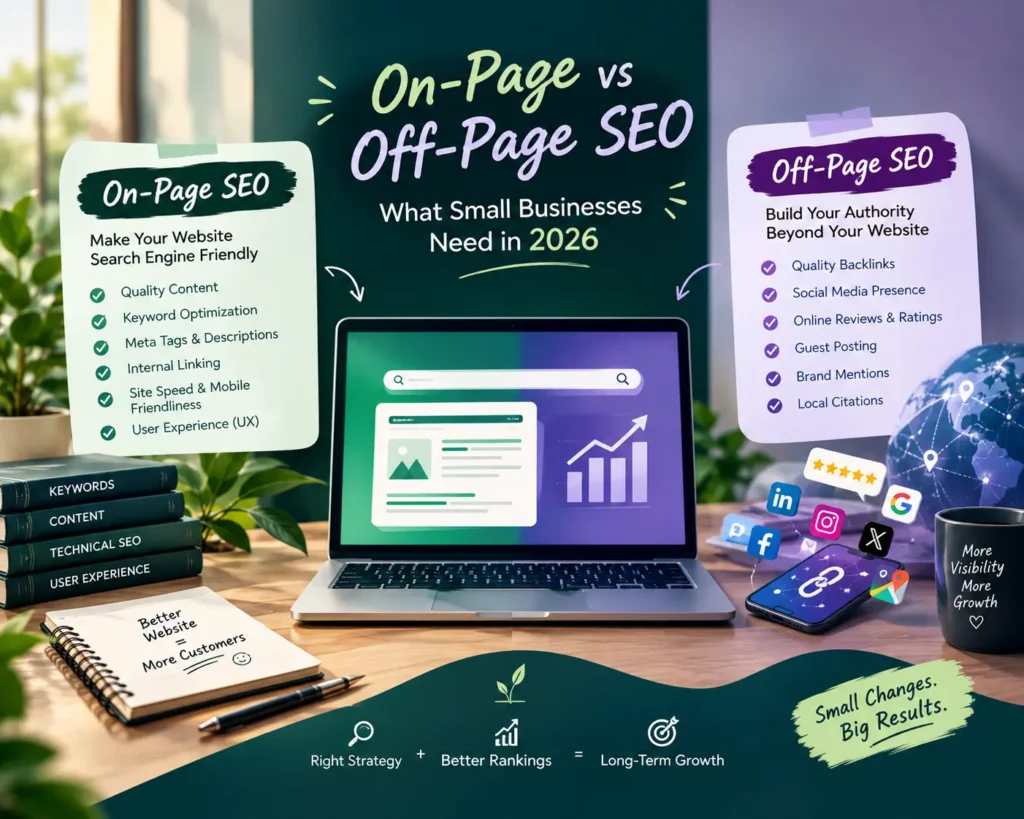
On-page SEO is what you control — content, structure, speed. Off-page is everything outside your site — links, mentions, reviews. You need both eventually, but on a limited budget you can’t tackle them at the same pace. Here’s what to prioritize, roughly what to spend, and where people go wrong.
On-Page SEO: Getting Your Own House in Order
Before inviting anyone over, you clean the house. If your site is slow, confusing, or doesn’t answer what someone typed into Google, nothing else matters much.
Start with title tags and meta descriptions — your first impression in search results. “Fresh Custom Cakes in Austin, TX — Joe’s Bakery” beats “Home — Joe’s Bakery” every time. Meta descriptions don’t move rankings directly, but they’re free ad copy, so treat them that way.
Headers matter too: one H1 per page, H2s for sections, H3s for sub-points. It helps both Google and actual humans figure out what they’re looking at.
On keywords — don’t stuff them in. Match the intent. Someone searching “best running shoes for flat feet” wants a comparison, not a product page trying to sell them something.
Most sites don’t fail because they’re too short. They fail because the content is vague — technically answering the question while saying almost nothing useful. Write like you’re talking to a real customer.
A few other essentials: link your pages internally (a blog post on hardwood floor care should point to your flooring service page), write real image alt text instead of “photo1234,” and check page speed at PageSpeed Insights — people bail on slow-loading pages fast. Make sure it works on mobile, since that’s where most searches happen now.
Think of on-page as your foundation. Off-page can bring people in, but if the site’s a mess, those visitors leave and the signal gets wasted.
Off-Page SEO: Your Reputation Out in the World
If on-page is cleaning the house, off-page is your reputation in the neighborhood. The nicest shop on the block still doesn’t matter if nobody’s talking about it.
Backlinks are votes of confidence — not equal ones. One link from a respected local news outlet beats fifty from spammy directories. Cheap bulk-backlink deals tend to hurt more than help; Google’s gotten good at spotting them.
Guest posting and digital PR work, but they’re slow. Local citations matter too — your business name, address, and phone number showing up consistently on sites like Yelp or your Chamber of Commerce. And your Google Business Profile is probably the single highest-impact off-page move for local businesses, since it’s what gets you into that local “map pack” at the top of results.
Social media probably doesn’t move rankings directly, but it drives traffic that sometimes turns into other sites linking to you. Even unlinked brand mentions get picked up as a small trust signal. And reviews matter a lot — respond to the bad ones too; it shows you’re paying attention.
Quick Comparison
| On-Page | Off-Page | |
|---|---|---|
| Control | A lot | Not much |
| Cost | Lower | Can get expensive |
| Time to results | Weeks–months | Months–year+ |
| Skill needed | Moderate | Higher |
| Risk | Low if done right | Higher — bad links can penalize you |
On-page is defense, off-page is offense. Good offense doesn’t mean much without a solid defense behind it.
What to Prioritize
On-page first, pretty much every time. Off-page brings signals to your site, but if it’s slow or confusing, none of it converts.
The exception: local businesses — plumbers, dentists, restaurants — should get their Google Business Profile and basic listings sorted early, alongside on-page work. That alone can generate calls within weeks.
Budget-wise: under $500/month, put about 80% into on-page — titles, content, speed, Google Business Profile. Skip link building. Between $500–$2,000, split roughly 60/40, still leaning on-page but adding listings and outreach. Past $2,000/month, run both at once — solid content plus real link-building.
Mistakes Worth Avoiding
Buying cheap backlinks is the big one — a $99 package of 200 links can trigger a manual penalty that takes months to fix. Chasing content volume while ignoring page speed is another; three blog posts a week won’t fix an eight-second mobile load. Leaving your Google Business Profile unclaimed is an easy, low-effort fix people skip anyway. And treating SEO as one-and-done is a mistake — algorithms and competitors keep moving.
What's Different About 2026
AI Overviews are changing how people click through — when Google shows its own summary, fewer people click into a site at all. Getting cited seems to come down to E-E-A-T: real experience and expertise that AI-generated filler doesn’t have. Thin content gets filtered out faster than before.
If anything, off-page trust signals matter more now. As AI floods the internet with content, Google leans harder on real links, mentions, and reviews to figure out who’s legitimate. The businesses winning combine genuinely good on-page content with real off-page credibility.
Quick Checklist
Claim your Google Business Profile and fill in every field. Run a speed test, fix anything under 50 on mobile. Check your top pages’ title tags. Confirm your top three pages actually answer the search intent. Update image alt text. Ask five recent customers for a review, spaced out naturally. Find and fix one broken internal link.
Bottom Line
On-page and off-page aren’t competing priorities — they’re sequential ones. Get your own site right first, then layer in the reputation-building work.
The businesses winning in 2026 won’t have the biggest budgets. They’ll be the ones who got the fundamentals right and kept going.